
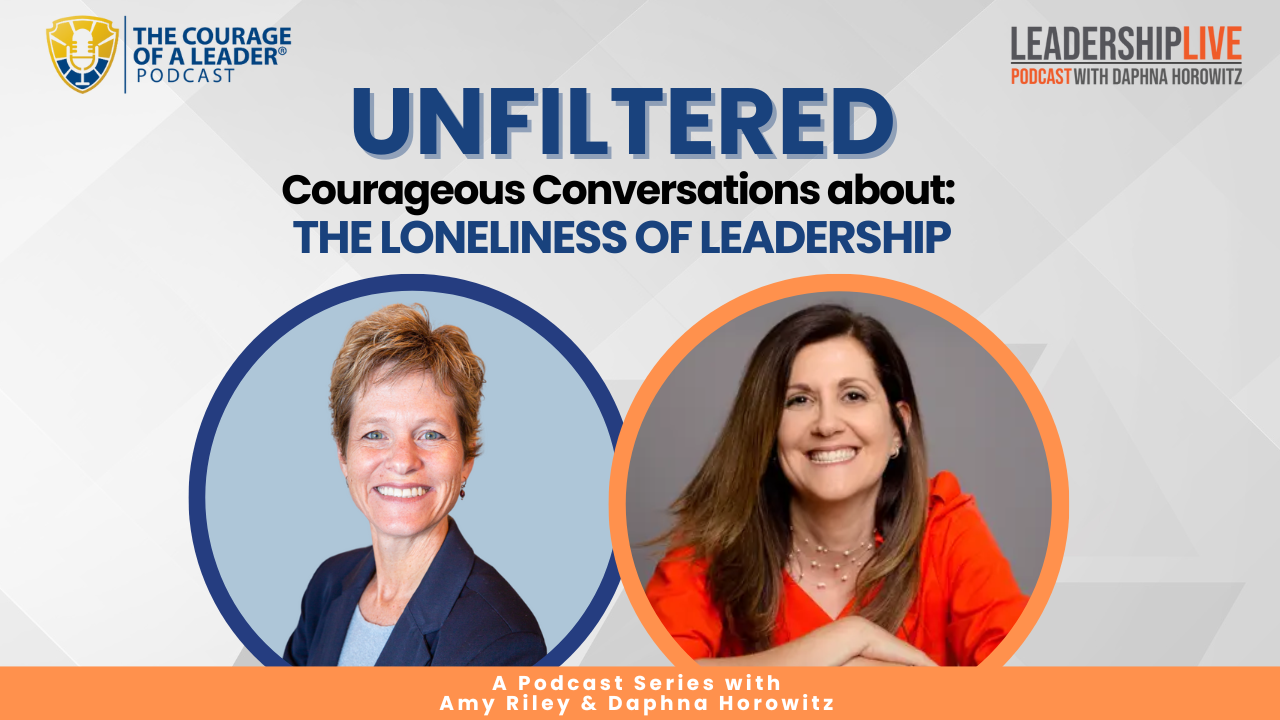
What if one of the greatest challenges in leadership isn’t decision-making or pressure but loneliness?
In this Unfiltered Series conversation, leadership experts Amy Riley and Daphna Horowitz get real about the isolation that often hides behind confidence and success. Even the most connected leaders can feel unseen when everyone’s looking to them for answers.
Amy and Daphna explore how this quiet loneliness shows up at every level of leadership and why it’s not a flaw but a signal—a call to pause, reflect, and reconnect. They share how to build your personal “A-Team,” drop the mask selectively, and find spaces where you can be supported as much as you support others. True leadership, they remind us, isn’t about standing alone at the top—it’s about finding the courage to lead with openness and connection.
Key Takeaways:
1. How to Recognize When Leadership Feels Lonely – Learn the subtle signs of isolation that most leaders overlook—and why noticing them matters.
2. Why Loneliness Can Be a Teacher, Not a Threat – Discover how reframing loneliness helps you grow instead of hiding behind busyness or success.
3. The Secret to Building Real Support as a Leader– Hear how to design genuine circles of trust that remind you you’re not meant to do it all alone.
4. What It Means to Drop the Mask Safely – Find out how to be open and authentic without losing credibility or composure.
5. Turning Loneliness into Leadership Strength – How connection and vulnerability can become your greatest sources of influence.
Connect with Your Co-Hosts
Daphna Horowitz
https://www.linkedin.com/in/daphnahorowitz/
https://www.facebook.com/PEACSolutions
https://podcasts.apple.com/ca/podcast/leadership-live/id1524072573
Amy L. Riley
https://www.courageofaleader.com
https://www.linkedin.com/in/amyshoopriley
https://courageofaleader.com/podcast/
Thanks for listening!
Thanks so much for listening to our podcast! If you enjoyed this episode and think that others could benefit from listening, please share it using the social media buttons on this page.
Do you have some feedback or questions about this episode? Leave a comment in the section below!
Subscribe to the podcast
If you would like to get automatic updates of new podcast episodes, you can subscribe to the, podcast on Apple Podcasts or Stitcher. You can also subscribe in your favorite podcast app.
Leave us an Apple Podcasts review
Ratings and reviews from our listeners are extremely valuable to us and greatly appreciated. They help our podcast rank higher on Apple Podcasts, which exposes our show to more awesome listeners like you. If you have a minute, please leave an honest review on Apple Podcasts.
Transcript
Announcer, welcome to our podcast series UNFILTERED.
Amy Riley:This is where we have Courageous Conversations about topics that
Amy Riley:are not always discussed in the mainstream or in the workplace.
Daphna Horowitz:Here we strip away the polished surface and
Daphna Horowitz:dive into the raw, messy and deeply human topics that we
Daphna Horowitz:don't think it talked about often enough.
Amy Riley:We are your unfiltered hosts. I'm Amy from
Amy Riley:the courage of a leader podcast,
Daphna Horowitz:and I'm Daphna from leadership live podcast
Daphna Horowitz:with two coaches from two sides of the world who believe that
Daphna Horowitz:real growth happens in the uncomfortable, unspoken moments.
Amy Riley:From Workplace trauma to dealing with major life
Amy Riley:changes and taboo topics like grief, imposter syndrome and
Amy Riley:menopause. This is the space where nothing is off limits.
Daphna Horowitz:So if you're ready for honest, bold and
Daphna Horowitz:sometimes messy conversations, let's get into it.
Amy Riley:You You can be surrounded by people all day
Amy Riley:long. Daphna, lots of meetings, lots of conversations, a team
Amy Riley:that's looking to you for direction, yet still feel alone.
Amy Riley:This is one of the most common leadership phenomenons, yet we
Amy Riley:don't talk about it much,
Daphna Horowitz:yeah, and that's why we're talking about
Daphna Horowitz:it today, right? Because it's not just about that feeling of
Daphna Horowitz:isolation. It's also about the weight of always having to be on
Daphna Horowitz:composed, capable, in control, having all the answers when
Daphna Horowitz:inside you really wanting to know that you can talk to
Daphna Horowitz:someone who really gets you so today, we're going to be having
Daphna Horowitz:this courageous conversation about the loneliness of
Daphna Horowitz:leadership and what it means to be carrying this
Amy Riley:yes, we are going to unpack why loneliness shows up
Amy Riley:in leadership, how it hides behind busyness and success, and
Amy Riley:what it really means to find connection that feels safe and
Amy Riley:real even at
Daphna Horowitz:the top, yes. So let's get unfiltered, yeah.
Amy Riley:Let's talk about this phenomenon. I know you and I
Amy Riley:both worked with leaders that talk about this loneliness that
Amy Riley:they feel in their work days, right?
Daphna Horowitz:And I think we mentioned a little bit before we
Daphna Horowitz:started recording this whole notion of loneliness at the top,
Daphna Horowitz:and maybe that's a good place to start to say it's not only at
Daphna Horowitz:the very, very top. We're not only talking about the
Daphna Horowitz:loneliness that if you're sitting at the top of the apex
Daphna Horowitz:as CEO, founder, or whatever it may be that you will feel
Daphna Horowitz:actually in every layer of the organization. When you're in
Daphna Horowitz:charge of a team or a certain business unit or project, you
Daphna Horowitz:might start to feel that loneliness. So maybe let's talk
Daphna Horowitz:a little bit about what does this mean? What is this
Daphna Horowitz:loneliness? So it can be at every layer of the organization,
Daphna Horowitz:and it doesn't have to mean that you're only at the top. And that
Daphna Horowitz:feeling of loneliness can be when you've made a transition,
Daphna Horowitz:or when you are feeling that you're running something, or in
Daphna Horowitz:charge of a whole of lot of things, and all of a sudden
Daphna Horowitz:people are looking at you, and people are looking to see, what
Daphna Horowitz:do you think? What do you look like? What is your mood? So you
Daphna Horowitz:start to have this awareness of needing to maybe be more planned
Daphna Horowitz:or more aware, or more composed, more structured around how
Daphna Horowitz:you're showing up.
Amy Riley:Yes, I think this is important point, Daphna, that it
Amy Riley:can happen at each of those transitions. We went from an
Amy Riley:individual contributor to a team leader. We're just a peer on the
Amy Riley:team, right? We're friendly with our teammates, and now we're the
Amy Riley:leader that got the management role right? Or now we're
Amy Riley:becoming a leader of leaders, or now we're a leader of the
Amy Riley:business, right? There's there's this responsibility, there's
Amy Riley:this sense of, I've got to know what to do here. People are
Amy Riley:looking to me. I can't have the same relationships that I had
Amy Riley:with these folks in the past. And it can bring with it a
Amy Riley:feeling of loneliness.
Daphna Horowitz:Yeah, you know, as you were talking, I was also
Daphna Horowitz:thinking that feeling of it's all up to me, that, that weight
Daphna Horowitz:of responsibility, of, actually, I'm in charge if something goes
Daphna Horowitz:wrong, it's all on me anyway. That is a big weight to carry,
Daphna Horowitz:and that can feel very lonely, because who's going to really
Daphna Horowitz:understand it to that level?
Amy Riley:Well, the buck stops with me, right? So I, and only I
Amy Riley:am the person who is ultimately responsible, right? You might
Amy Riley:have counterparts in your organization. There are other
Amy Riley:leaders in your organization, but you've got your team and
Amy Riley:your workload that you are responsible for.
Daphna Horowitz:I had a CEO that I worked with. He would say
Daphna Horowitz:to me often, he would say to me, at the end of the day, I am the
Daphna Horowitz:one losing sleep at night because of the business, and no
Daphna Horowitz:one else. People are coming, and they're coming for a job, and
Daphna Horowitz:they are, you know, getting paid for it, and at the end of the
Daphna Horowitz:day they can go home. And I think, and I do want to say, as
Daphna Horowitz:we talking about this and trying to give a sense of what does
Daphna Horowitz:this mean, it's not exactly true, necessarily, but it's the
Daphna Horowitz:feeling that we hold with ourselves when we have a level
Daphna Horowitz:of responsibility.
Unknown:Well, definitely it's why I do what I do, because I
Unknown:know when leaders are doing their job well and they're
Unknown:caring about the people and they're caring about the work,
Unknown:there's a lot of doing and there's a lot of thinking and
Unknown:responsibility that comes with that as well. I think it's also
Unknown:we've alluded to this, but I want to call it out specifically
Unknown:Daphna, this persona, or this professionalism, or this This
Unknown:portrayal, that we've got it all together, that I'm your
Unknown:confident leader. You can believe in me. Please feel good
Unknown:about your work and the work that you're doing every day,
Daphna Horowitz:right? I guess that's the other side of the
Daphna Horowitz:coin of that I'm the one who will lie awake at night worrying
Daphna Horowitz:about the business. So you can be rest assured, I've got this
Daphna Horowitz:I've got this handled, and then who do you talk to when you're
Daphna Horowitz:feeling stressed, when you feeling like actually, I don't
Daphna Horowitz:know if I've got it handled. I don't know if I'm making the
Daphna Horowitz:right decision. I don't know if this is the strategy to to
Daphna Horowitz:follow that feels very lonely, because who do you talk to? Who
Daphna Horowitz:can you really be vulnerable and open about some of your fears or
Daphna Horowitz:uncertainty or worry.
Amy Riley:Yeah, and Daphna, when we were preparing for this
Amy Riley:a little bit, because we like to have our conversations be
Amy Riley:unfiltered, don't over prepare, we were liking it to the parent
Amy Riley:child relationship, right? Of course, parents want to feel
Amy Riley:connected with their children, but there's also this idea that
Amy Riley:parents don't put all of their adult burdens onto the child,
Amy Riley:like they might know that mom's stressed, right? Or there's a
Amy Riley:lot going on with her work right now, right? Or my kids have
Amy Riley:known when my family members have passed away, mom's dealing
Amy Riley:with grief right now, but there's, there's a certain level
Amy Riley:that you share that and you create that connection. And so
Amy Riley:sometimes with team leaders, it feels like, okay, team members,
Amy Riley:please tell me as much as you feel comfortable telling me, be
Amy Riley:open. I'm here to here, and then can't quite feel like they can
Amy Riley:do fully the same in return.
Daphna Horowitz:I love that you brought up the parenting analogy
Daphna Horowitz:because I think it's very relevant here. Because what's
Daphna Horowitz:beautiful about parenting is that we maintain connection and
Daphna Horowitz:a very deep and loving connection with our children,
Daphna Horowitz:and yet we still maintain an element of we've got this. We
Daphna Horowitz:are a safe, secure space and home for our children. Very
Daphna Horowitz:similarly with leaders who, for me, that brings in that whole
Daphna Horowitz:paradox of, while we encourage leaders to be real and authentic
Daphna Horowitz:and open and share what they can about what they're going through
Daphna Horowitz:and how they're feeling. They need to do that with a sense of
Daphna Horowitz:connection, because I think that's really important for the
Daphna Horowitz:team, but also with a sense of this is a safe place, and I've
Daphna Horowitz:got this handled, and that's a little bit of a paradox here,
Daphna Horowitz:because you can be open, but not totally open with absolutely
Daphna Horowitz:everyone all the time. I think that's the distinction here.
Daphna Horowitz:It's not like, Okay, I wear my heart on my sleeve wherever I
Daphna Horowitz:go. It's actually be discerning about who, when, what and how,
Daphna Horowitz:and that starts to build that kind of support system. And I
Daphna Horowitz:know we don't really want to go there right now, because there's
Daphna Horowitz:still quite a lot to discuss. But and we want to stay in that
Daphna Horowitz:level of tension of, what does this what is this tension that
Daphna Horowitz:this loneliness creates before we move into, okay? How do we
Daphna Horowitz:move out of it that I think it's important to to understand that
Daphna Horowitz:for me, that paradox, you know,
Amy Riley:yes, and the cost, the cost of this paradox, yeah,
Amy Riley:feeling lonely has us feeling unsupported. At times we can
Amy Riley:feel the fatigue, the decision fatigue, all of those key
Amy Riley:decisions are on me as the leader, I've got to make them
Daphna Horowitz:the pressure. I think there's huge pressure to
Daphna Horowitz:bring your best, know the answers, make the right
Daphna Horowitz:decisions, create the right strategies, set a vision. I
Daphna Horowitz:think there's huge pressure, and that comes with the cost.
Daphna Horowitz:There's also physical cost. We've seen the research that
Daphna Horowitz:says, first of all, we spoke about research as well, and
Daphna Horowitz:there's plenty of research to say that more than 50% of
Daphna Horowitz:executives and CEOs feel that loneliness, and they feel that
Daphna Horowitz:it impacts their performance. And secondly, the physical and
Daphna Horowitz:emotional impact is huge, whether it's burnout,
Daphna Horowitz:depression, physical health, you know, really literally ailments,
Daphna Horowitz:heart disease, and all of those come with those pressures of
Daphna Horowitz:feeling like you're very alone in the situation. Connection
Daphna Horowitz:helps to build health, and we know that as we're talking
Unknown:about the impacts, the cost of this loneliness at the
Unknown:top, I'm like, I feel like, then this becomes compounding, right?
Unknown:Like, because when I'm feeling overwhelmed and I need to make
Unknown:decisions and I'm burnt out, and the responsibilities with me,
Unknown:like, I'll withdraw. Many folks faced with those kinds of
Unknown:pressures isolate. I gotta put my head down. I got to figure
Unknown:this out.
Amy Riley:Yeah, yeah. Rather than having those be the moments
Amy Riley:that I reach out and connect in a meaningful way, yeah, instead,
Amy Riley:we're putting our foot on the gas even harder. I got to figure
Amy Riley:all this out by my lonesome.
Daphna Horowitz:No, and I think that this is even an indicator.
Daphna Horowitz:That could raise a red flag for people that are experiencing
Daphna Horowitz:maybe the loneliness, but aren't even maybe able to label it as
Daphna Horowitz:loneliness. Something that's coming up for me is, how would
Daphna Horowitz:someone know that they're experiencing loneliness, unless
Daphna Horowitz:they're really feeling lonely, and maybe it's not an experience
Daphna Horowitz:that everybody can connect to but I do think that sometimes
Daphna Horowitz:it's that exactly what you said, that level of isolation. I'm
Daphna Horowitz:hunkering down, I'm working out harder, I'm putting in more
Daphna Horowitz:hours. I'm busier than ever. Just take a moment and look at
Daphna Horowitz:that. You know, do you really need to be in that space? Are
Daphna Horowitz:you bringing people in to your workspace? Are you sharing the
Daphna Horowitz:load? Are you sharing the conversation? I think that's
Daphna Horowitz:maybe an indicator of loneliness, or a symptom of
Daphna Horowitz:loneliness. If there are any more of those, maybe like it had
Daphna Horowitz:me
Amy Riley:think about a giving support, getting support
Amy Riley:continuum Right? And how much are you giving support,
Amy Riley:listening, providing ideas, helping to remove barriers for
Amy Riley:others, or just being with others, emotions and reactions
Amy Riley:you're giving that support. I love that, how and who and from
Amy Riley:whom and where are you getting?
Daphna Horowitz:Getting it exactly when you're noticing
Daphna Horowitz:you're on the giving end, the holding space, giving answers,
Daphna Horowitz:making decisions. You're the one that everybody comes to. That's
Daphna Horowitz:actually an indicator as well. And I had another one come up
Daphna Horowitz:for me, which is that feeling of no one really understands me. I
Daphna Horowitz:think that is a very big one. People just don't get me. They
Daphna Horowitz:don't get this, they don't get the pressure. They don't get
Daphna Horowitz:what I'm doing, they don't get how much I'm responsible for.
Daphna Horowitz:People just don't understand. I think that that is that's
Daphna Horowitz:something that comes up for you as you going through your day to
Daphna Horowitz:day. That's actually an indicator of that level of
Daphna Horowitz:isolation that you might not be
Amy Riley:noticed, that I like that, yeah, because those feel
Amy Riley:like really real words that could go through our heads, and
Amy Riley:very real words that I've heard from leaders sitting across from
Amy Riley:me, we can also check in with our energy. Daphna, human beings
Amy Riley:have a natural sense of wanting to belong, right? Even though we
Amy Riley:talked about in our introversion episode that there's different
Amy Riley:needs for processing out loud or spending time thinking and
Amy Riley:talking through with others, but we have a natural sense of
Amy Riley:wanting to belong as humans, and if we feel like we don't have
Amy Riley:our team or our community where we belong and where we can
Amy Riley:really show up our full selves and lean on others,
Daphna Horowitz:yeah, and that actually is really also, I feel
Daphna Horowitz:there's a bit of nuance there as well, in terms of, yes, we want
Daphna Horowitz:to feel that we belong, but when we say, when we've been promoted
Daphna Horowitz:to a level of leadership, or now we the CEO, we can't feel like
Daphna Horowitz:we fully belong. On some level, there's always a little bit of
Daphna Horowitz:distance. So maybe there will be the company party where there's
Daphna Horowitz:a barbecue and everybody comes together, and it feels really
Daphna Horowitz:good, but when you are leading a team, there's always that little
Daphna Horowitz:bit of nuance of, do I really belong in this space? Can I
Daphna Horowitz:really share what's going on for me, or do I have to keep some of
Daphna Horowitz:that back? And yeah, I mean, I often talk about the leadership
Daphna Horowitz:gap, because that's exactly. What's there. It's sitting in
Daphna Horowitz:where you are relative to where your team is. And there's there
Daphna Horowitz:might be gap, I know in some companies, it's bigger or or
Daphna Horowitz:smaller, and that's something to look at as well in terms of
Daphna Horowitz:competence. But I'm not talking about the competence here. I'm
Daphna Horowitz:talking about the feeling of being part of the team. You
Daphna Horowitz:certainly can be and you can create that connection, but
Daphna Horowitz:you're also just a little bit separate,
Amy Riley:yes, and definitely you're having me think I work
Amy Riley:with many leaders, specifically in fast moving industries. The
Amy Riley:example I'm thinking of right now happens to be from a tech
Amy Riley:industry. Some of that gap is very much desired created. I
Amy Riley:know many leaders who encourage their teams to have their teens
Amy Riley:channel without them on it, right? I forget how they
Amy Riley:referred to that. But players only, players only where they
Amy Riley:feel like they can say to each other, just like siblings would
Amy Riley:say to each other some things they might not say to the parent
Amy Riley:or the Guardian, right, that they can have their discussions
Amy Riley:about what is and is not working. I know that gap, like,
Amy Riley:needs to be, you know, like, in some
Daphna Horowitz:ways, to be there interesting. I know my
Daphna Horowitz:kids have a group, and I feel very left out. I would love to
Daphna Horowitz:know what they are talking about, without us, the parents,
Daphna Horowitz:but it's true, there's something in that peer connection that is
Daphna Horowitz:really important, that it needs its own space as well. So that's
Daphna Horowitz:actually a lovely thought as well. Very interesting. So
Daphna Horowitz:where, if you're the leader, which group are you going to be
Daphna Horowitz:part of? You know, right? Yes, and feel incredibly lonely. So I
Daphna Horowitz:think should we maybe look at, how do we shift this narrative a
Daphna Horowitz:little bit, the tension, the loneliness, the Who do I really
Daphna Horowitz:speak to? How can I really show up? And I think it's really
Daphna Horowitz:important, and we mentioned it a little bit before, but it's
Daphna Horowitz:really finding your real circle, finding the people. It's the
Daphna Horowitz:when, what, how, and I don't know what, I had four of those
Daphna Horowitz:before, but who, who, who? Because I really believe that
Daphna Horowitz:it's not about, okay, I'm just going to be open. It's actually
Daphna Horowitz:really choosing the people that you can feel comfortable with to
Daphna Horowitz:open up when you've had a hard day, or when you made a mistake,
Daphna Horowitz:or you made the wrong decision and there was a big what you put
Daphna Horowitz:like an oopsie or whatever, you know, failure, or whatever it
Daphna Horowitz:was something didn't work out the way you wanted, find people
Daphna Horowitz:that you can talk to about it. Because I think that's really,
Daphna Horowitz:really important,
Amy Riley:yes. And as leaders, you're going to have to probably
Amy Riley:design this, create it yes, because this is a phenomenon
Amy Riley:loneliness at the top, because it doesn't get organically
Amy Riley:created for us.
Unknown:So we gotta be don't wait for it. Yes, yeah, don't
Unknown:wait for
Amy Riley:it. Intentionally build this circle. It could be
Amy Riley:your counterparts. It could be leaders at your level. It could
Amy Riley:be other trusted leaders or mentors inside of your
Amy Riley:organization, outside of your organization, it can be friends
Amy Riley:and family to as well.
Daphna Horowitz:Yeah, I don't know if I'm dating myself with
Daphna Horowitz:this analogy, but okay, I call it the A Team. Did you ever
Daphna Horowitz:watch The A Team? Yes, and you know how there were four of
Daphna Horowitz:them, and each one had a very specific role and a very part, a
Daphna Horowitz:specific part to play with their own personality and their own
Daphna Horowitz:style. And I think you've got to, I don't
Amy Riley:remember it as well as you do. Daphna, I like this.
Daphna Horowitz:Okay, regardless, build your a team,
Daphna Horowitz:your outstanding a team that's going to be different people for
Daphna Horowitz:different purposes or different roles. So have your coach, have
Daphna Horowitz:your trusted advisor, have your mentor, have your partner, have
Daphna Horowitz:your all the people that are going to help you feel
Daphna Horowitz:supported, develop and critically challenge your
Daphna Horowitz:thinking when required, help you to just vent and offload if
Daphna Horowitz:that's what you need, and share some of the emotional burdens,
Daphna Horowitz:and, you know, help you brainstorm to think through some
Daphna Horowitz:of your very important decisions that you need to make.
Amy Riley:Very well said, Daphna and I would add only that
Amy Riley:make sure at least one, maybe a couple of those folks are ones
Amy Riley:that you can reach out to when you're feeling messy, when
Amy Riley:you're when you're really in the thick of it, you could be upset
Amy Riley:or have some emotion flowing in that moment. Who is someone that
Amy Riley:you can trust? In those moments, yeah, that know that that aren't
Amy Riley:going to think, oh, Amy's just a disaster. Well, I know that this
Amy Riley:is just a moment, yeah, right, and I can support her in it.
Daphna Horowitz:You know, I think that as we're talking
Daphna Horowitz:about this, and I'm getting the feeling that this is a difficult
Daphna Horowitz:conversation, because I think there are two elements to this,
Daphna Horowitz:and I know that a lot of the executives and CEOs that I work
Daphna Horowitz:with have their a team in place. They've got a really good number
Daphna Horowitz:of advisors. Yeah, that they will really interesting and not
Daphna Horowitz:even, not even the board of directors or the official
Daphna Horowitz:advisory board. It's an unofficial advisory board,
Daphna Horowitz:because they still have to maintain a certain image or
Daphna Horowitz:level of composure and competence towards their own
Daphna Horowitz:board. So it's people they can go to outside to discuss
Daphna Horowitz:dilemmas such as hiring or decision making or strategy or
Daphna Horowitz:anything like that, but that is very kind of professional and
Daphna Horowitz:and expert level. And I'm just hearing some of my clients say,
Daphna Horowitz:but I don't need therapy, and I don't need to talk about my
Daphna Horowitz:emotions, and I don't need to, you know, so I'm saying
Daphna Horowitz:sometimes it's important to have, like I said, the A Team.
Daphna Horowitz:Have someone on your a team that is also that person that you can
Daphna Horowitz:speak to when you are feeling down, as you said, when things
Daphna Horowitz:haven't gone well, and you can just offload and share that
Daphna Horowitz:without worrying about making a bad impression or what they're
Daphna Horowitz:going to think about you, yeah.
Amy Riley:Or you can drop that mask selectively,
Daphna Horowitz:exactly, selectively that's good
Daphna Horowitz:intentionally, yeah, intentionally and selectively.
Daphna Horowitz:And know that Simon Sinek, who's really I love his work and his
Daphna Horowitz:approach, talks about people you can cry with, and he was
Daphna Horowitz:incredibly open and vulnerable in the interview I heard with
Daphna Horowitz:him, where he said he's got a few really good friends that he
Daphna Horowitz:can pick up the phone and say, I just need to talk to you
Daphna Horowitz:something happened, and I need to let off some steam, and I
Daphna Horowitz:need to cry, and I know like bringing up the whole crying
Daphna Horowitz:thing is going to generate, you know, others, but
Amy Riley:show emotion. Be able to show emotion exactly of
Amy Riley:whatever kind
Daphna Horowitz:it is, yourself, and be real. And as
Daphna Horowitz:you said, Let down that mask a little bit.
Unknown:Yeah, I want to recap and then add one more these ways
Unknown:that we've been talking about shifting from isolation to
Unknown:connection. You've said, find your circle. Design it
Unknown:intentionally. Design that trust in our world. Drop the mass
Unknown:selectively. And then we'd also say, slow down.
Daphna Horowitz:I think that is key in the busyness of our day
Daphna Horowitz:to day. It's so easy to just move on to the next thing and
Daphna Horowitz:ignore what's going on and just stay busy.
Amy Riley:Keep reacting, keep reacting, keep reacting. But are
Amy Riley:we checking in with ourselves? Because we need to do that, to
Amy Riley:slow down and see where are we energetically? Do we do we feel
Amy Riley:like there's no one to talk to, or no one gets me in this
Amy Riley:moment? Do we feel like we've given all the support today and
Amy Riley:haven't had any supportive moments for ourselves?
Daphna Horowitz:Yeah, and I want to offer a reframe for our
Daphna Horowitz:listeners. I think this is really important. I think for
Daphna Horowitz:me, this is the crux of this whole topic, and I know we
Daphna Horowitz:discussed it as well, is that this loneliness and the symptoms
Daphna Horowitz:and what it looks like and what it feels like is actually a
Daphna Horowitz:signal. It's a signal not a flaw. It's a signal that comes
Daphna Horowitz:to tell you, here you are. You are at this place. You're
Daphna Horowitz:feeling these feelings because you've reached something, you
Daphna Horowitz:have accomplished something, and maybe it's a sign that something
Daphna Horowitz:is required of you, whether it's a learning or something that you
Daphna Horowitz:need to be doing differently, or something that you need to be
Daphna Horowitz:paying attention to, in terms of who do you need to bring into
Daphna Horowitz:your circle? Now, it really is all part of your evolution and
Daphna Horowitz:growth process as a leader. So see it as a signal and ask it.
Daphna Horowitz:What is it asking of us? Now, this feeling, what is this
Daphna Horowitz:feeling requiring or wanting from us? And then we can really
Daphna Horowitz:take it to that next level of okay, what is the signaling to
Daphna Horowitz:me?
Amy Riley:Yes, I love this Daphna, and it's such a powerful
Amy Riley:reframe. It's a signal, not a flaw. Because really, if we're
Amy Riley:growing in our leadership and we're stepping into one of those
Amy Riley:transitions that we talked about earlier, or a new level of
Amy Riley:responsibility. There is going to be, by design, times where we
Amy Riley:don't have the structures and the systems and the people in
Amy Riley:place to best support us in those moments happen, yeah,
Amy Riley:there's going to be those gaps as. As we grow, and how do we
Amy Riley:make sure we you got to intentionally set up something
Amy Riley:in those moments. Otherwise it's going to become naturally
Amy Riley:isolating, and it might for a time. But then how do you
Amy Riley:reframe and shift to those connecting activities
Daphna Horowitz:Exactly, exactly, and to really, maybe
Daphna Horowitz:even take it a step higher and say, Okay, I'm welcoming this
Daphna Horowitz:now. I'm welcoming this as part of my journey. You know, yeah,
Daphna Horowitz:this is uncomfortable. It's unpleasant. I'm noticing it, and
Daphna Horowitz:it's really a part of the journey. I love what you said.
Daphna Horowitz:It's a given. It's a given. As you go higher up in the layers
Daphna Horowitz:of an organizational structure, you are going to feel it more
Daphna Horowitz:and more by design. It's just how it is, but it indicates
Daphna Horowitz:you've achieved that you've reached a level of
Daphna Horowitz:responsibility that is high. You are successful. So that comes
Daphna Horowitz:with some stuff that you need to notice, acknowledge and and
Daphna Horowitz:really give space for and understand what's required to
Daphna Horowitz:manage it.
Amy Riley:Yeah, so it's a question and a moment of
Amy Riley:stillness that invite you all to sit in you can hit pause right
Amy Riley:now or after you finish listening to this podcast
Amy Riley:episode, right What are you experiencing? Is there
Amy Riley:loneliness existing right now?
Unknown:Acknowledge the growth that indicates and yeah,
Daphna Horowitz:ask and choose. This is asking of us. What is
Daphna Horowitz:the learning here and who do I need to bring in? I think that
Daphna Horowitz:is a big question. Who do I need to bring in? It's a moment of
Daphna Horowitz:reconnection, and it could be reconnection with someone else.
Daphna Horowitz:I guess it could be a moment of reconnection with ourselves as
Daphna Horowitz:well. Do I need to bring myself in? Do I need to take a moment
Daphna Horowitz:just to do something that will make me feel more connected to
Daphna Horowitz:the leader that I am, the person that I am, the life that I'm
Daphna Horowitz:living.
Amy Riley:Yeah, yeah, yeah. Beautiful. Beautifully said, we
Amy Riley:all are the only ones that can answer those questions in the
Amy Riley:moment. Troy, yeah, we've given some guidance here today, but
Amy Riley:know that this is a phenomenon that happens in leadership.
Daphna Horowitz:Completely normal, completely normal. And
Daphna Horowitz:if you know someone who needs to hear this, please share it.
Daphna Horowitz:Leave a comment. Pass this episode on and let us know what
Daphna Horowitz:other topics you'd like us to talk about on future episodes of
Daphna Horowitz:unfiltered, let's keep this dialog going.
Amy Riley:Yes, we would love to and until next time, stay
Amy Riley:courageous, stay curious and stay unfiltered.
Daphna Horowitz:That's a wrap on this episode of unfiltered,
Daphna Horowitz:where we have courageous conversations about topics that
Daphna Horowitz:are not often discussed in depth. We hope this conversation
Daphna Horowitz:sparked something in you, whether it's a new perspective,
Daphna Horowitz:a moment of reflection, or just the reassurance that you're not
Daphna Horowitz:alone. If
Amy Riley:you found this episode meaningful, please share
Amy Riley:it with someone who needs to hear it, and if you have a topic
Amy Riley:that you'd love for us to tackle, let us know we are
Amy Riley:always up for conversations that don't get talked about
Daphna Horowitz:enough. Don't forget to subscribe. Leave a
Daphna Horowitz:review and connect with us on LinkedIn. All our details are in
Daphna Horowitz:the show notes, because the best conversations don't end here
Amy Riley:until next time. Stay curious, stay courageous and
Amy Riley:stay unfiltered. Foreign. You.




 A Summary of The Courage of a Leader® 4 Pillars