
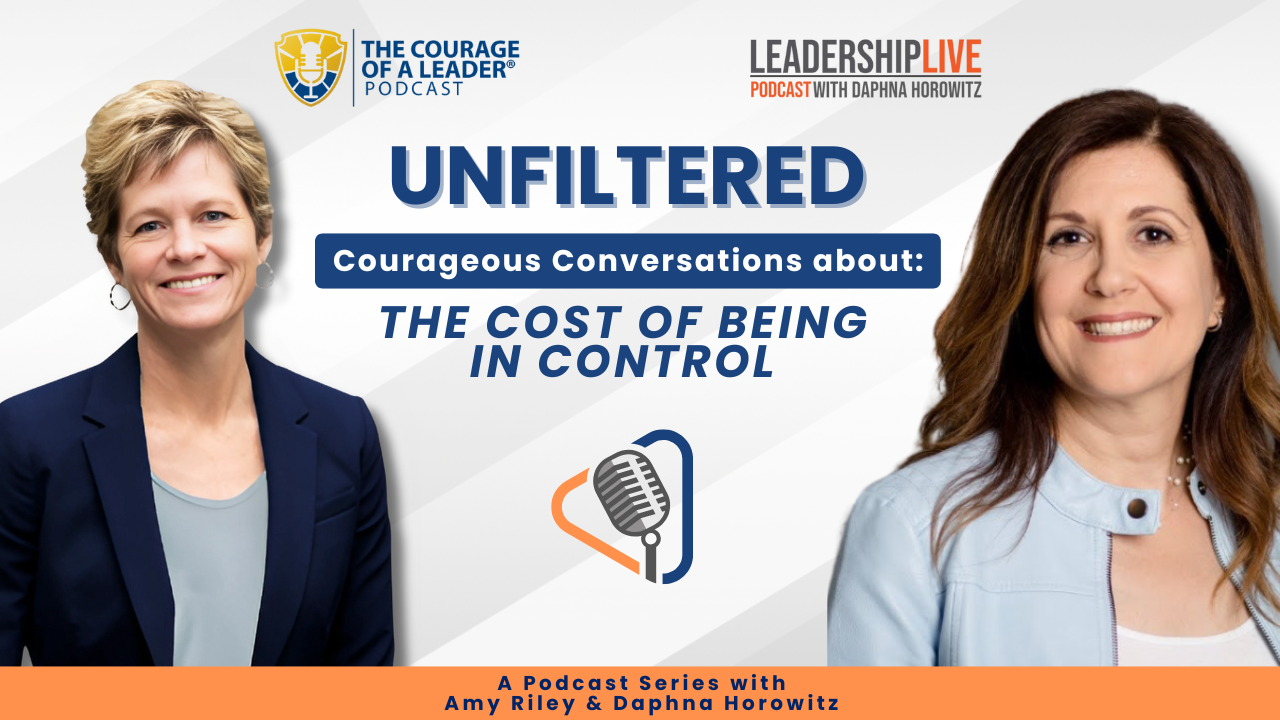
We all want to do things well — to be responsible, stay on top of it, make sure nothing slips through the cracks. But when does that turn into control?
In this episode of UNFILTERED, Daphna Horowitz and Amy Riley get honest about the fine line between responsible leadership and the need to control everything. They unpack why leaders grip so tightly, what it costs in terms of energy, creativity, and trust, and how letting go can actually be a deeper form of wisdom.
Join Daphna and Amy for a raw, relatable conversation on hidden control, delegation of authority, and the courage it takes to loosen your grip without letting things fall apart.
Key Highlights
01:15 – The Illusion of Holding It All Together
03:15 – Hidden Control: Responsibility in Disguise
08:40 – The Bottleneck of Decision-Making
13:30 – The Illusion of Being ‘On Top of It’
17:45 – The Fear Beneath Control
22:00 – From Dependency to Capacity: The Real Leadership Shift
27:15 – Control Lives in the Body
30:30 – The Four Shifts: Transparency, Collaboration, Curiosity, Boundaries
34:15 – Moment of Stillness: Letting Go as Wisdom
Connect with Your Co-Hosts
Daphna Horowitz
https://www.linkedin.com/in/daphnahorowitz/
https://www.facebook.com/PEACSolutions
https://podcasts.apple.com/ca/podcast/leadership-live/id1524072573
Amy L. Riley
https://www.courageofaleader.com
https://www.linkedin.com/in/amyshoopriley
https://www.courageofaleader.com/podcast/
Thanks for listening!
Thanks so much for listening to our podcast! If you enjoyed this episode and think that others could benefit from listening, please share it using the social media buttons on this page.
Do you have some feedback or questions about this episode? Leave a comment in the section below!
Subscribe to the podcast
If you would like to get automatic updates of new podcast episodes, you can subscribe to the, podcast on Apple Podcasts or Stitcher. You can also subscribe in your favorite podcast app.
Leave us an Apple Podcasts review
Ratings and reviews from our listeners are extremely valuable to us and greatly appreciated. They help our podcast rank higher on Apple Podcasts, which exposes our show to more awesome listeners like you. If you have a minute, please leave an honest review on Apple Podcasts.
Transcript
Daphna Horowitz:
We know what we're doing. We've done this. We spend so much of our energy trying to hold it all together, our teams, our goals, our brand, our family. But what if the tighter we grip, the more we actually lose?
Amy Riley: Yes. And as leaders, we can think about this as being responsible. yet sometimes that can turn into holding on, controlling too tightly.
Daphna Horowitz: Yeah, and that's what we're going to be talking about today. Control and beyond the control freak, why leaders crave it, what it costs, and how letting go might actually be the most powerful thing you can do.
Amy Riley: I'm excited for this conversation, Daphna. Let's get unfiltered.
Daphna Horowitz: Yeah. So what are we actually talking about today? What is this thing called control? Because I'm imagining that a lot of the listeners out there are thinking, but I'm not such a, maybe they recognize they're a control freak, but I don't micromanage, I don't do everything. So how do we make it tangible? Yes.
Amy Riley: Yeah, I think we want to make it clear, Daphna, that we are talking about leaders and leadership behaviors that can come from really great intentions, yet it's really easy to spill over into being too controlling. Yes. An example to start with, could be, we wanna be prepared. We wanna be on top of things. We wanna make sure our meetings are really efficient and effective. Yet we could spill over into controlling the discussion too tightly, cutting off any objections, right? Not letting any topics go off tangent ever. And we might be losing some richness in the conversations that could emerge.
Daphna Horowitz: Yeah, and that actually makes me think about a conversation I recently had with two founders that I'm coaching at the moment. And they were asking me, why is it that we are the ones doing all the talking in the meetings? We have an executive committee meeting and no one is participating. It's just me and my co-founder all the time. And I had to ask them to step back and think about it because in their mind, it wasn't control. It was we stepping in because no one else is. But why is no one else in it? Why is no one else contributing? And it could be the over-preparation, but I think in their case, it's under-preparation because they are holding all the ideas in their head. Everything is clear as day to them in their head, but they haven't shared it. They haven't structured it. So they've got all this stuff to download and they're not really creating space and an opportunity for their leadership team to pitch in.
Amy Riley: Yes, yes. So it's hidden control, yeah, hidden control. Hidden control, right? It could also be the person who feels like the responsibility, the ownership stops with me. So if something's not working, I gotta jump in and figure it out. I've got to insert myself. I've got to grab that report and review it at the last minute.
Daphna Horowitz: I've got to be on top of everything because if I'm not and the business fails, it's my responsibility. So it's holding everything and wanting to be so on top of it that there's no room for error, experimentation, other people to come in.
Amy Riley: Yes. Yes. Yeah. That could also be a leader that's holding all the decision-making. Yes. Right. Like I need to be responsible. I need to make those decisions. And of course that can cause bottlenecks. We'll talk more about the impacts of that. I know.
Daphna Horowitz: I know. I actually want to just dwell on this a little bit longer because I think this is such an important one because I call it the bottleneck for decision-making. And I often ask the leaders that I work with, where are you the bottleneck? in decision making, because when we're talking about letting go, and I think this is a topic that's very closely related to this control, there's control versus letting go. And when you ask leaders or tell them or share with, they suggest that they should be letting go more, they often don't even know what that means. And it goes beyond the delegation of tasks, which they've already mastered at this stage. It's really about delegation of authority, delegation of leadership. What kind of decisions are you actually willing to let others make, even though you're not sure what will come out of it? What will they do with it?
Amy Riley: Not just letting others do, but letting others decide as well.
Daphna Horowitz: Yeah. I've got another CEO who will not have any new hire coming to the business without them approving it first, which is crazy. You can imagine, bottleneck, time, energy, process gets lengthened. So that is one thing, recruitment. hand over at certain levels, you know, let other people make those decisions.
Amy Riley: Yeah, a couple more examples to share Daphna, because I think here, we want every leader to see themselves in this, that very well intentioned, non micromanaging managers can get into situations where they're over controlling for very good intentions. But it slips over into that other side. Another example can be wanting to be a data-driven leader, decision maker, right? We got to have the data. We got to have the data, right? And that can lead to, we got to drill in here. We got to get this much more data. We got to get this much more data. And Daphna, we're moving into a lot of new spheres. in our workplaces. And sometimes there's not the data.
Daphna Horowitz: Sometimes the data you need or want just doesn't exist in the entirety that you would like it to be in for sure. For sure.
Amy Riley: Yeah. Sometimes leaders want to stay connected, want to make sure that they understand everything that's going on in their team or in their division. And that can lead to wanting to be copied on everything, wanting to be in the know on every conversations, every interaction, actions that are being taken. And that can begin to feel like too much. Sometimes leaders are like, I have to know what to tell my boss when they come by and ask for an update.
Daphna Horowitz: Right, right, right. And that is under the guise of I have to be on top of it. If I don't know what's going on, then I'm not on top of it. But is that true? I mean, we're going to look at that. Like, what are the fears and things driving it? But I do want to add one more, and that is measuring worth through productivity. And that is if I'm busy, if I'm busy all the time and I'm involved and I know what's going on, then I'm doing a good job, you know? So my worth as a leader, as a contributor to this organization is validated
Amy Riley: That's integral to the organization. I'm contributing. I need to be involved.
Daphna Horowitz: I'm doing. I'm busy. And I know that with that, there's also the staying in that zone of excellence. We know what we're good at. We're very good at it. This is why we were hired. But as you kind of rise in the levels of leadership, You don't need to prove your excellence in those areas anymore. You need to be evolving into more strategic thinking, into leading and getting things done through others. And that looks different. And yeah, there's also fear in there of, well, what do I do if I'm not doing the thing that I'm best at? you know.
Amy Riley: Right, right. Yeah, yeah. Have to keep doing that instead of like setting up the conditions for your teams, your associates to do the work well.
Daphna Horowitz: And another one that I know many people complain about is that not enough information sharing. So controlling the flow of information and also saying, will share stuff on a need-to-know basis. So if you need to know this, so you only give your people a certain amount of information because you think that's all they need to know in order to do their job.
Amy Riley: Well, you also can be thinking that I'm protecting them. My organization is full of information and I don't want them to get distracted by this or that. Or I don't want their brains and their energy to get hijacked by such and such thing. So you're trying to control what information gets to them.
Daphna Horowitz: And how controlling is that? I don't want them to get distracted. That is pretty controlling. Right? Do you know what else is coming up for me? I don't know if this is, tell me in the States if this is something that you recognize, but there's a big conversation going on about the blue check marks on WhatsApp. Do you know about that? The red receipts? Okay. Yeah, because I know in America, you use WhatsApp a little bit less. But on WhatsApp, for people who do use it or in other places in the world, it's a messaging system, like a direct messaging thing, where there's a check mark, you get two check marks if people have read and if people have opened. and then they turn blue when they've actually opened, but you can disable that functionality. I've disabled my blue check mark, so people can't tell if I've opened their message. There's a big conversation about how selfish that is because other people can't tell if I've read their message.
Amy Riley: Oh my goodness. Yes.
Daphna Horowitz: Now I'm saying if we bring it into control, who's been controlling here? I'm letting it go. I'm saying, okay, you can see it's been delivered. You can see that it's got to where it needs to go. When I read it is my business. You don't have to know that I've opened it or read it. And people are getting very anxious around that. I don't know if they've read my message or they, I sent it 10 hours ago and I still haven't had a response.
Amy Riley: They've read it. Why haven't they responded? Yeah.
Daphna Horowitz: That could be similar to email reads and receipts. You know, they've received my email. They've read my email. Why aren't they answering? That triggers anxiety and control issues. It was a thought that came in.
Amy Riley: Is that getting to a level of information where it's then really easy to get into controlling thoughts about it? Exactly. Right? How quickly are they reading? How quickly are they responding? Why aren't they responding? Now my brain is making up stories about that. That's interesting. I hear it from the teenagers in the messaging, right?
Daphna Horowitz: They left me unread. Exactly. They left me unread. It becomes a whole mechanism that I just feel feeds into this need to control. We might not recognize it as a need to control. It's just the need to know, or some people might call it a social, I don't know what, etiquette. But actually it does line that. So I think the interesting question here is really looking at what behaviors do we have that give us some kind of a hint or a clue at wanting to control something that is outside of our area of control.
Amy Riley: Exactly. Yeah. So Daphna and I just shared with you listeners a number of examples. I know I could see myself in a couple of them. And we invite you all to see yourself inside of this, because I think that this is something that well-intentioned, caring leaders can start to grip. and control too tightly in an area or two. So identify where is your slippery slope? Where is it easy for you to shift into holding on too tightly?
Daphna Horowitz: Which of these examples could you relate to? And maybe you can think of others that we haven't mentioned that are part of your repertoire of wanting to have that feeling of staying on top of it or being involved or caring for people or wanting to get things right. But it does have that underlying tone of really wanting to be in control and finding it hard to let go.
Amy Riley: Yeah. Yeah. So having my own business and having a team that helps me with back office, tasks, if you will. I'm thinking particularly about them right now. I can feel like it's my business. I shouldn't put the burden on them of making certain decisions. But honestly, my ops manager handles all my invoicing and such. If she's not sure how a business partner wants something invoiced, just ask the business partner. You don't have to check with me first. But I noticed that she was checking with me. And I'm like, hmm, what have I set up here that she doesn't feel like that she has the ownership to just handle that part of the business?
Daphna Horowitz: Yeah, and I think even I just want to just double click on that because even when you think, oh, it's just a little thing. I'll just do it. It will be quicker for me to do it. And I know exactly what I'm doing. It will take me longer to explain it than to just do it myself. You're actually training your people to let you do a lot of the stuff. So then it becomes easy. Oh no, Amy will take care of it. Daphna will do it. She knows how. It's quicker. I'll just hand it back to her. Yes. Loading yourself with unnecessary tasks, yeah, actually.
Amy Riley: Absolutely. The Courage of a Leader recently introduced a product called the Clarity Kit. And Daphna, I got in there thinking, I need to test this in all the different environments. And I really should have just slowed down and connected with my team member, Bea, I'm like, where are we at? What testing do we think is necessary? How do we want to do that? But I jumped in like, I got to be the responsible one. I've got to test this. I got to make sure the shopping cart and the delivery mechanisms are all working exactly the way that they're supposed to. And I know I tested something we didn't need to test. You know, I know I caused a little extra flurry of activity that didn't need to be there. Instead of slowing down, having a conversation, let's plan this together. She was closer to the technical work that we were doing on that.
Daphna Horowitz: Yeah, and let her do it then. So let's, I think this is a good time to move into what's underneath that, because I think that's really useful to explore. What is the the fear, the worry, the anxiety underneath that needing to control. So we've spoken about how it comes in the guise of caring or wanting to get things right or wanting to make sure it's done properly or all those things or just do it quickly. But what's underneath that really? And I think that is a good question for everyone listening to just ask yourself for a minute, just step back and say, okay, here's the behavior that I'm doing. And no, it's not really that empowering to my team. It's probably something I could let go of, but Why? What's driving me to actually take that on? And I think some common ones are, if I don't get it right, my business will fail, you know? Yes.
Amy Riley: Yes. Our reputation is at stake. That was one for me with introducing this Clarity Kit. What if somebody clicks through and it doesn't work the way that we want it to look?
Daphna Horowitz: This is going to look terrible. professionalism, reputation, credibility, and also you're the business owner, or you're the business head, or whatever it may be. At the end of it, if it fails, people are going to be looking to you, or you carrying responsibility, or you have to pay those salaries at the end of the month. So those are the taking, wanting to be responsible, but taking over responsibility. And how does it hold us back? How does it hold us back? Because I'm sitting here thinking, maybe there are people going, okay, So, okay, so I take responsibility. I do it. I can handle it. I'm managing it. What's the downside?
Amy Riley: What's the cost? What's the cost? Yeah. I've had this conversation with a number of leaders, DAFNA, who are resistant to delegate, right? And actually some have admitted, like, I have control issues, right? Like, I can do this at a high level of quality. I wanna make sure this continues to get done at a high level of quality. And also that fear, just going back to fears for a moment of, if I delegate all of this, like, are people gonna wonder what I'm doing? Right, right. Oh, I lost the thread, Daphna. What was, oh, the impact that it had. The cost, yes, the cost. Yeah, then we are not developing those around us. We are impacting their motivation if we jump in at the last minute and we are taking over or we are over-testing, right? Then my team member can be thinking, what, you don't trust me to have this set up right?
Daphna Horowitz: So I think the one thing that's coming up for me as you're talking is this whole concept that I work with, which is, are we creating dependency or building capacity? Because I think that when you are always in charge, always in control and really delegating tasks, you are building dependency because at the end of the day, nothing can move forward without you. But when you're starting to understand what letting go can do and really letting go of some of those decisions and authority and leadership, you are building capacity and you're building a layer of leadership that can start to operate independently. which means that you get to do, and I say this to the senior leaders and CEOs that I work with, you are paid the big bucks to drive forward, to bring up the big vision and ideas. And how many times do CEOs feel frustrated that they don't feel they can move forward at the pace that they want to because they're constantly being pulled down into fighting fires, managing crises, you know, digging in the weeds and correcting mistakes. You want to be able to take that level up, but you can't take that level up until you learn to let go. Let go and allow people to make mistakes.
Amy Riley: Absolutely. And what that does, Daphna, is that engages your team and your workforce.
Daphna Horowitz: They feel like they're a part of something.
Amy Riley: Dare I say, we are in an engagement crisis right now, right? And if we take the decisions from people, if we jump in and fix in the last minute, then we are not giving them autonomy. We're not giving them ownership. And that creates engagement, and that creates care, right? If I get to own this part of what we do, and I get to make the decisions inside of that, I show up and I feel a different way about my work. I'm more engaged. And this is what we need if we're going to move forward with velocity.
Daphna Horowitz: Right. Right. Exactly. So that's the cost. The cost is disengagement from your team, not feeling like you trust them and they don't feel empowered to actually make decisions. They don't feel like their job is meaningful or impactful because they become kind of just the doers or the implementers. Yeah, and I think I also want to add the cost to you because understand that The more in control you are, the more at risk you are for exhaustion, burnout. And even if we don't get to that level, it's like the level of stimulation and creative thinking that you actually really want to be operating at, you can't, you don't ever feel like you can really get there. And that's something that is a cost to you.
Amy Riley: Yeah, even if, as I've been talking about the examples of control and what we do, like those of us who are watching a video version of this, right? Like I'm leaning forward in my chair, I'm clenching up my stomach, I'm gripping my hands, right? Like that's what it feels like to try and stay on top of all of that. It creates tension and stress in our bodies. And for some, it can feel uncomfortable to sit back and let go. Let things happen. Right?
Daphna Horowitz: I love where you've taken us. I love where you've taken us because notice your body. Notice what's going on in your body, right? What you're describing is what does it feel like in our body when we want to be in control? There's a tightness. There's a gripping. There's a tension in our body. Creativity and innovation does not come from tension and control. We know there's a reactivity that happens when we're in tension, right? We're much more in reactive space. Like I mentioned earlier, that firefighting mode, managing crises, managing problems sometimes can give us a huge sense of satisfaction and adrenaline. but that's not where our creative thinking space lies. And I think as leaders, we need to be thinking of how do we break boundaries? How do we forge ahead? How do we move forward? We wanna do that level of creative thinking that we can't do. We're in the tension of that control. So I love bringing the body in and noticing what that feels like in the body.
Amy Riley: Yes, and getting more comfortable with sitting back and being curious, like, okay, wait a minute, this initially feels off topic for me. But my team members who are great at doing this work are initiating this different kind of conversation. Maybe there's something here. Maybe there's an idea. Maybe there's something to see. Can I let this conversation be and see what emerges rather than always controlling
Daphna Horowitz: the conversation, keeping it right on task. Right, so remember Amy, if I can bring that up when we were planning for this episode, right? Episode on control and what does control look like and what did we do? We straight away wanted to control what will this episode be and what are we going to talk about and how are we going to talk about it, which is fair, I mean that's fine, a level of planning, but then we caught ourselves in saying, hold on a sec, what if we just let it flow I'm controlling the control conversation. Controlling the episode on control. It's like, give that a breath. And it really is. It's about taking a breath for a minute and saying, OK, what's going to emerge? And sometimes from that flow, a lot of things will emerge that you would never have expected. And those could be quite pleasant and surprising and positive.
Amy Riley: Yes, absolutely.
Daphna Horowitz: I actually have another story I want to share, which I think is relevant for here. And that's, I was coaching a CEO on a problem that he was having with his business that he wanted to take it forward in some way. And it's something he'd been racking his brains about for a long time. And then he brought it into the coaching and he said, listen, I need to solve this problem. I absolutely, it's enough. I need to, something needs to break free here. And I said to him, instead of us two solving it in this session right now, why don't you bring this problem to your leadership team? See how they respond and what ideas they will have because I'm sure they will come up with things that you and I will not think about in this moment. And for me that really indicated this is a good level of letting go because his pattern was spot the problem. find the solution, bring the solution to the leadership team so that they can implement. But I said, take it a step back and don't bring, spot the problem. Great. That's your gift. Don't try and solve it and bring it. Actually solve it together. And that was just a really, it was a really big aha moment for him in terms of taking that next level of leadership, you know, that he was complaining about, that he can't and the, why don't they come up with ideas and why don't they contribute more? And here we had an example of, What pattern of behavior are you in that is just creating this environment?
Amy Riley: Yes, I love that, Daphna. I just recently had a conversation with the leader. There had been a reduction in force and they were going to have to reorganize the tasks and the roles. And this leader felt like they needed to sit in their office and figure this all out on a piece of paper. Right? And then we started talking about what could be the benefit of bringing others in, of asking everyone, right? Like, we're going to need to reshuffle this. What do you see as your strengths? What are you interested in? Right? But then it was, well, what if there's nobody interested in this part? OK, we'll deal with it. You'll figure it out, right? It'll get assigned somewhere. It needs to be taken care of, right? But if you could line up as much as possible with what they're good at, what they're interested in learning more about, how is engagement and just the change process going to go inside of that team?
Daphna Horowitz: Exactly. So I know we wanted to talk a little bit about that shift from control to letting go and trust. I think that's a big part of it. And we were saying how. having transparency instead of always wanting certainty. Just open it up for conversation, which is really what we've been talking about now.
Amy Riley: Say what you know, say what you don't know. I also think it can be transparency about the process. Right now, I just want to gather ideas. Or right now, I just want to make sure everybody understands the opportunity inside of us. Sometimes people get confused about what kind of conversation are we having right now? Exactly. Are we deciding? Are we exploring? Are we what? So that transparency is important.
Daphna Horowitz: So important. I'm thinking also of restructuring processes where transparency is limited. You can't share everything, but if you do share what you can, even if you don't have answers, just share, this is what's going on. This is what we're in the process of. I don't have all the answers for you right now, but that transparency goes a long way and it can mitigate some of that need for certainty. It's like, okay, it's uncertain, but we're talking the uncertainty.
Amy Riley: Yes. The next shift word we wanted to share was collaboration. You can also think of this co-creation. Instead of perfection, instead of having to have all the answers yourself, How can you collaborate? How can you co-create? How can you bring people in?
Daphna Horowitz: Which is the example that we just brought in, actually, of the problem of the restructure. Okay, the third one we wanted to talk about is curiosity. Stay curious. Instead, and it's linked to the collaboration, but stay curious. Ask questions. Learn more. Think, what about this do I want to know more about? And even if I think I have the answers, To encourage more creative thinking and more conversation, ask questions instead of always telling what to do, how to do it, giving the answers.
Amy Riley: Wait a minute. Wait a minute. What could emerge here? Yeah, exactly. Yeah. And then boundaries was our fourth. Like boundaries, sometimes it's guardrails, right? If we are sharing that ownership, that autonomy, what are the guardrails? What are the boundaries that folks need to stay in between? And what are the boundaries for all of us as leaders, right? What are our boundaries? Like I'm not going to be asked to be copied on every email. What actually do I need to be updated on? Can a bi-weekly touch base handle that? What are my boundaries to ensure that I'm not getting overly involved?
Daphna Horowitz: I think when you're working with your team, it's really important to actually have that conversation. Here's what I need to know. Here's what's going to help me understand the process. I don't want to get involved in every single bit of information that happens. Thinking of the situation that came up today that a client wanted to change a session and my assistant starts telling me. He's suggesting this time and he's suggesting this time and I'm going, I don't want to know any of that. When it's changed, let me know that it's changed, you know. So having that conversation, to what level do I need to be involved in this conversation, in this project, in this, yeah. And for the other way as well, for you to let your boss know what would work for you in terms of getting things done in an empowered way.
Amy Riley: Yes. Transparency about boundaries for ourselves and up and out. Yes. So those shift words were transparency, collaboration, curiosity, and boundaries.
Daphna Horowitz: Yes, yes. So is this time for our moment of stillness? Yes. Okay, we wanted to frame, we're trying to frame our episodes now with something, a moment of stillness to take a breath and give you something to take away and think about as a result of this conversation about control. So what is our moment of stillness for today?
Amy Riley: Our moment of stillness is, where in your leadership are you holding to tightly?
Daphna Horowitz: Yes, yes, yes, yes. I love that. And I want to add to it that letting go doesn't necessarily mean letting it fall apart. Because sometimes I think there is that connection. And possibly it's reframing that into letting others step in and starting to understand. So I think it ties in beautifully with where are we gripping too tightly? Where can we bring others in?
Amy Riley: Yeah, beautiful. So much wisdom, so much possibility. in learning to loosen the grip.
Daphna Horowitz: Yeah, yeah. Because letting go is not weakness. It's actually wisdom.
Amy Riley: It is. Listeners, if you know someone who needs to hear this conversation, please share it, leave a comment. We'd love to know what resonates. We'd love to know what else you would like us to tackle in an unfiltered conversation. Let's keep the dialogue going.
Daphna Horowitz: So until next time, stay curious, stay courageous, and stay unfiltered.



 A Summary of The Courage of a Leader® 4 Pillars